
WOO is moving to revenue-driven buybacks and getting a new visual identity
WOO Stake shifts from staking yield to buybacks funded by WOOFi protocol revenue, arriving alongside a new visual identity and a focus on RWA liquidity onchain.
TL;DR: WOO Stake is shifting from staking yield to buybacks funded by WOOFi protocol revenue. As WOOFi grows, the protocol buys more WOO, and every holder benefits from that, regardless of where they hold their funds. The change arrives alongside a new visual identity and a focus on real-world asset (RWA) liquidity onchain.
Growth that reaches every holder
WOOFi launched WOO Stake in 2021, giving users the freedom to claim either USDC or WOO with protocol revenues. Over time, WOO Stake distributed over $10M in rewards to WOO holders and attracted over 30% of the total WOO supply.
However, recently the amount of WOO staked, and overall demand for the token has tapered off.
There were several systemic issues with the staking model:
users can opt to earn USDC, which doesn’t benefit every token holder, only themselves
WOO tokens bought back by the protocol and given to stakers can be eventually sold, reversing the positive impact of the buybacks
Some centralized businesses with custody were staking their users’ assets and not passing on the yield
Centralization risks occur, with large amounts of WOO stored in smart contracts
In 2026, 37% of revenue shared was taken directly in USDC. This leaks hundreds of thousands per year which could be buying back WOO and removing supply from the market.
Introducing WARP: WOO Automated Repurchase Protocol
In recent years, several other bluechip DeFi protocols including Hyperliquid, EtherFi, Lido, Aave and Uniswap have become net deflationary in their tokenomics by activating fee switches or buyback programs that take their native tokens off the market, which has proven effective in both market impact and narrative.
WOO now joins them.
WARP is an AI-driven buyback protocol, powered by @StarchildOnX, that places a series of market and range orders on Uniswap to buy back WOO and send it to a multisig wallet. Once in the multisig, the funds will be held indefinitely, similar to Hyperliquid’s Assistance Fund.
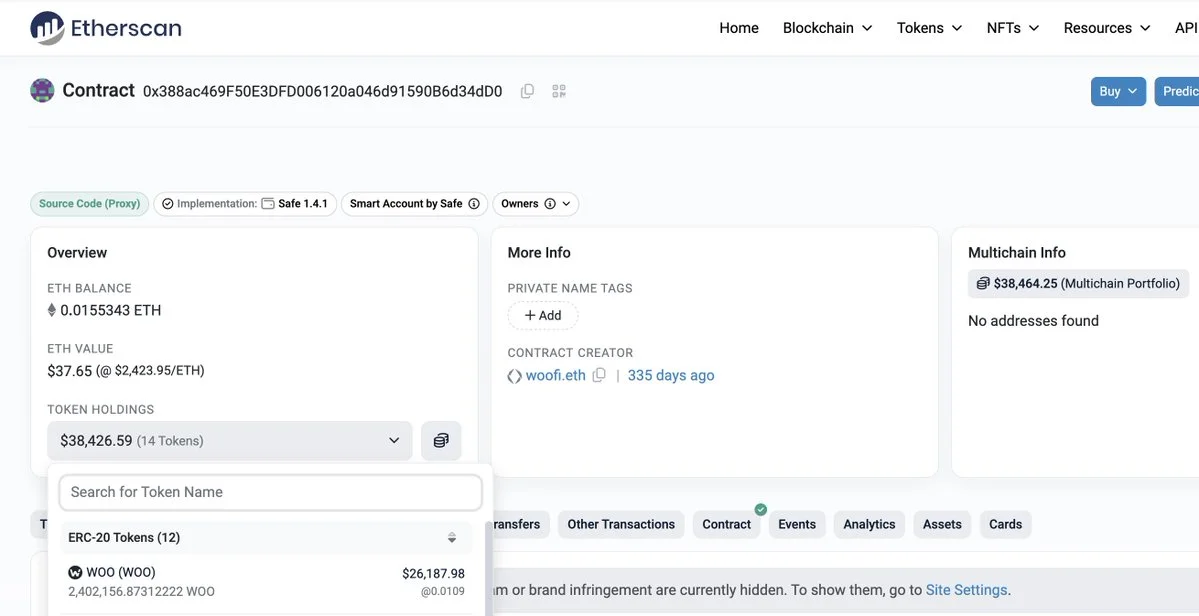
This agent is funded using revenues from WOOFi. Each week the total bought back will be announced, and can be viewed on Etherscan.
Over the next few months, we will evaluate the effectiveness of the agent, optimize WARP, and announce clearer frameworks. If you are currently staked, you are under no pressure to unstake, but your staked WOO will not be earning yield, so you can remove it if you choose.
One brand family for WOO
WOO is adopting a new brand system, bringing WOO, WOOFi and Starchild under one consistent look. Starchild had been using the orange and black monolith design, but it created additional brands to manage and fragmented attention. Now the monolith design is being adopted by WOO to highlight recent innovations and cleanly separate from the legacy utilities and applications it was once building.
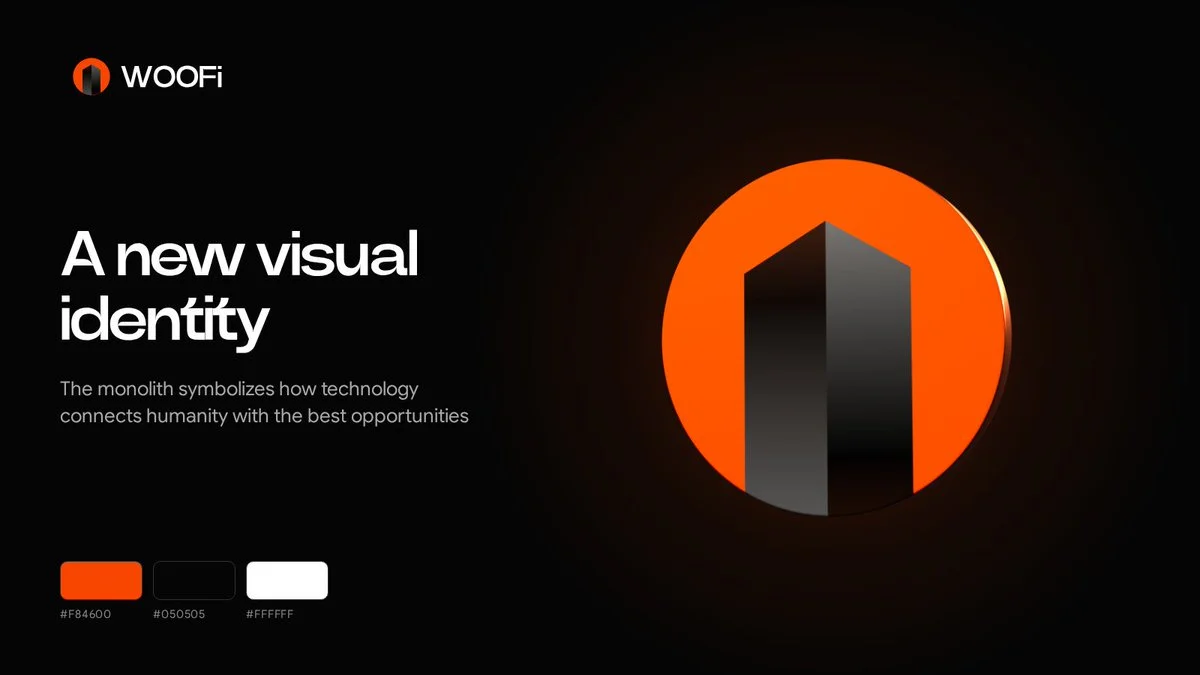
What the monolith symbolizes:
The monolith at the center of the new token represents a step forward for humanity, where the innovations and technology of the future meet the real world of today. Its deep orange is instantly recognizable, while the black and white palette ensures our applications maintain the clean, professional look and feel expected of them.
What changes today:
Our socials and website move to the new identity starting today. You will see the updated logo, colors and visuals across X, LinkedIn, Gitbook, and our official website, woofi.com.
Visual changes to the token:
We will roll out the token visual update over the next few months, working with data platforms, wallets and exchanges so the new WOO mark appears the same everywhere holders see it.
We considered a full token swap. A swap would put the burden on holders: new contracts, migration steps, and cutoff dates that many would miss. A visual update gives WOO a fresh start while every holder keeps exactly what they hold today, with nothing to do.
The destination: Real world assets and agentic finance
Distributed tokenized RWAs reached about $38.6B across 39 networks on October 1, 2026, according to rwa.xyz. Forecasts for 2030 range from about $2T (McKinsey) to $16T (BCG), and Standard Chartered projects $30T by 2034.
Why WOOFi is built for this:
Tokenized stocks, treasuries and commodities take their price from markets that live offchain. WOOFi's synthetic proactive market maker (sPMM) quotes trades against oracle reference prices, so it can offer tight pricing on assets whose true price is set elsewhere.
RWA liquidity is spread across chains and issuers. WOOFi already routes swaps across 10+ chains, so users can reach an RWA from whichever chain they are on.
Earn vaults let RWA and crypto holders put idle assets to work. Their deposits deepen the liquidity WOOFi offers, which brings better prices and more traders, while bringing unique yield opportunities just for holding an asset.
How that translates to growth
Each new RWA market brings new traders and new volume. More volume means more protocol revenue, and more revenue will fund larger WARP buybacks. Growth in RWAs flows straight back to WOO.
Over the next few months, we will improve the infrastructure around WOOFi's RWA liquidity and add support for more chains and assets. Alongside that, we are rebuilding the WOOFi app from the ground up, an overhaul designed to take WOOFi to the next level. Our expertise gained from building Starchild taught us a lot about how we can apply AI agents and agentic UI for a better user experience.
A note to holders and stakers
To everyone who has held, staked, and built with WOO through every market cycle: thank you. Your support and belief in our community have not gone unnoticed as we build the future of onchain liquidity.